2025-11-11 - RADIO Antenne d'Oc
INTERVIEW

Listen to the interview
If you would like to learn more about Nympheus Limunansis, I invite you to listen to my interview on Radio Antenne d'Oc.
(French)
https://antenne-d-oc.fr/laurence-saunois-illumine-figeac-avec-nympheus-luminansis/
The Full Interview
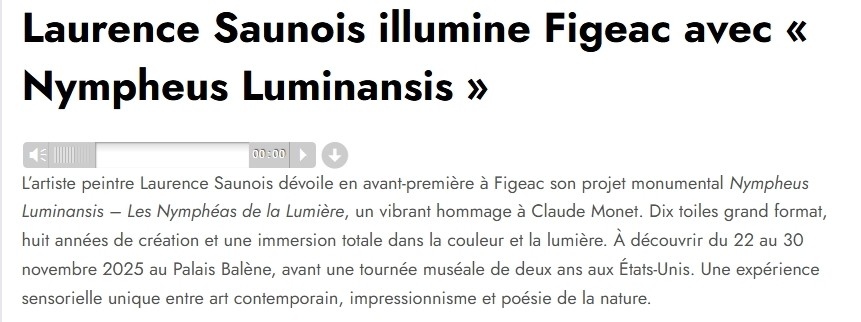
Journalist: Hello everyone. Painter Laurence Saunois presents her monumental project Nympheus Luminansis, the Water Lilies of Light, a vibrant homage to Claude Monet, in Figeac. This large-scale work, the fruit of eight years of relentless effort, invites viewers into an immersion of color and light. The exhibition will be open to the public from November 22 to 30, 2025, at the Palais Balène in Figeac, before departing on a two-year museum tour across the United States. This preview brings together contemporary art, a tribute to Impressionism, and a poetic look at nature: a sensory and contemplative experience at the heart of the "real Impressionism" the artist claims. A major cultural event for Figeac, a city of art and history.
Hello, Laurence.
Laurence Saunois: Hello.
Journalist: How are you doing today?
Laurence Saunois: I'm doing very well, thank you so much.
Journalist: It's a real pleasure to have you with us today. We're talking about art, and as someone who is deeply passionate about it, it's wonderful to discuss such a beautiful subject. You work on large-format canvases, but before we dive into that, Laurence, what inspired you to create this project and exhibition?
Laurence Saunois: It's a bit of a special story. I was traveling for work near Giverny, and toward the end of the day, my partner and I thought we couldn't be so close without visiting Claude Monet's gardens. So we went around 4 or 5 in the afternoon. There were still a few people, but then the crowd dispersed. We found ourselves completely alone: we visited the empty house—a rare experience—and then moved on to the Water Lily pond. When I saw the pond, its colors, and the light, I thought it was extraordinary. I was seeing everything as a painting, something that had never happened to me before. I could see the trees, the flowers, the water, and the water lilies moving, vibrating, shifting in color and brightness... It was incredible, a deeply intimate feeling. As we walked back to the car, I turned to my partner and said, "I have to paint these water lilies, and it will be called Nympheus Luminansis, the Water Lilies of Light." That's how the project was born.
Journalist: Wow, that's beautiful! Does that mean that when you first discovered the Water Lilies, you immediately projected yourself into the work? Did you start imagining the techniques to capture the light right then and there?
Laurence Saunois: It was truly exceptional. I saw everything as if it were already a painting—it's hard to explain. I just knew I had to do it. Leaving that garden and the house, where I saw Claude Monet's studio completely empty—when it's usually packed with visitors—there was a very special atmosphere with that late-afternoon light. It touched me deeply. The name Nympheus Luminansis came to me instinctively as I walked. When I returned home to Figeac, looking at the photos we took, I saw exactly what I needed to paint.
Journalist: The paintings aren't just simple photographs...
Laurence Saunois: Far from it, even if they might give that impression from a distance because the technique is so precise. Up close, you can clearly see it's paint. Unlike some of my hyperrealistic work, this is entirely different. It blends real, figurative elements with Impressionism in certain areas. That's why I call it "real Impressionism": a blend of my core artistic identity (realism and hyperrealism) with a sense of letting go toward something more sensitive, drawing on my impressions rather than simply copying a photograph.
Journalist: Hence the phrase "real Impressionism." Would you call this project a tribute?
Laurence Saunois: Absolutely. A hundred or a thousand painters would see the same garden and paint it differently. For me, it's a tribute to what I felt regarding color and light. It isn't a reinterpretation of Claude Monet's works, but rather my personal interpretation of what I experienced in that garden.
Journalist: How would you describe your technical approach to this Impressionist world?
Laurence Saunois: Technique-wise, Monet painted directly onto white canvas. In my case, I sketched and painted directly onto white canvas without any underpainting: my subject was applied directly. This approach allowed me to work with color and light through successive glazes. That's why the project took so long. Depending on how light strikes the canvases, the artwork shifts, and the atmosphere changes. I wanted to pay homage to both Monet's work as a gardener and his mastery as an artist. Seeking light is essential to me as an artist—light is what brings an artwork to life behind every color.
Journalist: For those unfamiliar with the technical side, what is the difference between painting on a bare white canvas versus a toned or colored background?
Laurence Saunois: It comes down to transparency and light reflection. I had my paintings scanned in high definition by a specialized company. The technician explained that the scanner captures the reflection of light off the canvas, revealing the successive layers of paint. When you start with a colored background, the way light reflects back to the viewer is entirely different.
Journalist: Given the large scale, the painting La danse de la lumière (The Dance of Light) took over 1,000 hours to complete. What stages and emotions did you go through?
Laurence Saunois: That first painting is very personal. When we visited Giverny, my partner was beginning to show early symptoms of ALS (Charcot's disease), though we didn't know it yet. Those 1,000 hours spanned four years: two years while I was caring for him during his illness, and two more years after he passed away to rebuild my life. Working on this piece helped me cope. In total, the whole project represents eight years of my life.
Journalist: Before heading to the United States, was it important for you to host this debut exhibition in Figeac?
Laurence Saunois: Extremely important. Figeac is a town of art and history that deeply appreciates the arts. It's my hometown at heart—my family comes from the Lot region, and my grandfather lived in Figeac. It was essential for me to share this exhibition with the local public before it leaves.
Journalist: Nature plays a central role in your work. What does nature represent to you?
Laurence Saunois: Nature is vital. Without nature, we are nothing—we are an integral part of it. I started out as a generalist painter, then a wildlife painter. For this series, I focused on representing nature and the ponds of Giverny.
Journalist: How do you feel about the exhibition traveling to the United States?
Laurence Saunois: It's deeply emotional. It's every artist's dream. It represents an immense amount of work, but also tremendous joy. The first stop will be in Connecticut, just north of New York. I'm excited to meet the museum curator and tour organizer, who placed their trust in me after seeing only the very first piece, La danse de la lumière, back when the rest was just a vision. I'll be eternally grateful to them for that trust.
Journalist: You're following in the footsteps of great artists like Monet and Rosa Bonheur, whose works also toured the U.S...
Laurence Saunois: In their footsteps, hopefully! I hope to have a wonderful journey ahead. You have to follow your dreams—they really do come true sometimes.
Journalist: I saw that a book documenting these eight years of work is also coming out?
Laurence Saunois: Yes! It's currently being printed and will be available during the exhibition at the Palais Balène. I designed the entire layout myself. It features all the artworks with detailed commentaries, the history of Claude Monet, his gardens and water lilies, as well as my own garden in Figeac and the genesis of the project.
Journalist: Thank you, Laurence. As a reminder, the exhibition will run from November 22 to 30 at the Palais Balène in Figeac, with Laurence present throughout. Where can people learn more about your work?
Laurence Saunois: On my website: www.laurencesaunois.net.
Journalist: Thank you so much, Laurence, and wishing you great success in Figeac and across the U.S.!is !